
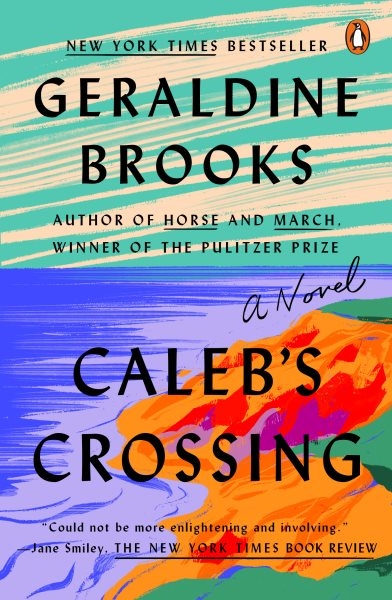
I have been on a bit of a Geraldine Brooks kick lately. Having recently read Horse, I decided to immerse myself in an earlier novel of hers, Caleb’s Crossing (2011). This novel takes as its source another little-known historical fact: in 1665, after much study and preparation, including the learning of Hebrew, Latin, and Greek, a Wampanoag man applied for admission to the first institution of higher education in North America, Harvard. He was accepted and went on to attend there.
Brooks expands on this fragment of information to tell a sweeping story that speaks to both the realities of early colonial life and the impact of colonization on First Nations people. Her chosen point of view is that of Bethia, a girl who grows up on Martha's Vineyard, where the Wampanoag made their home, and develops a clandestine friendship with Cheeshahteaumauk, aka Caleb, the future Harvard student, at a young age. Their friendship, along with circumstances beyond Bethia’s control, take them both to Cambridge, and, needless to say, the plot thickens there.
I thoroughly enjoyed Horse, as, like Caleb’s Crossing, it immersed me in history. Caleb’s Crossing, however, may be my favorite of the two books. It brought to mind The Scarlet Letter by Nathaniel Hawthorne, and also the writing of the early colonial era poet Anne Bradstreet, who features as an off-stage character in the novel. Like Bethia and Cheeshahteaumauk, Bradstreet also aspired to more than the strictures of her culture and time allowed. Inspiring stories, both historical and fictional, all around.